What Is The Best Way To Get Fast Reliable Internet Out To A Backyard Studio?
Wi-Fi that covers the kitchen rarely survives the trip across a lawn and through an insulated wall. Here is how to plan the network for a premium garden office before the trench closes.
Why the Wi-Fi that works indoors dies in the studio
Most buyers assume the house router will reach the studio because it already reaches the patio. It usually does not, and the reason is the building itself. A premium garden office is built to hold heat, which means thick insulation, a continuous air barrier, sometimes foil faced sheathing, and low emissivity glazing with a thin metallic coating. Those layers are excellent at stopping radiant heat and mediocre for you in one specific way: they also attenuate radio signal. Add fiber cement or metal siding and the studio can behave like a partial Faraday cage. Signal that seemed acceptable when you stood outside the framed shell during construction can collapse once the envelope is closed. Related: How Do You Choose A Backyard Studio That Works Year Round?
Distance compounds the problem. The faster 5 GHz and 6 GHz bands that make video calls feel effortless lose strength quickly across open ground, so a studio forty or sixty feet from the house often falls back to the slower, more congested 2.4 GHz band. The connection still shows bars, which is why so many owners misdiagnose the issue. What they experience is not a dead link but an unstable one: calls that freeze for two seconds, large uploads that stall, a cloud drive that silently stops syncing. For a room whose entire purpose is uninterrupted work, that is a failure. Treat connectivity as part of the build specification, not as something to sort out after the furniture arrives.
Keep reading: How Do You Choose A Backyard Studio That Works Year Round?, What Separates A Real Garden Office From A Decorated Backyard Shed?, Which Permits And Zoning Rules Apply Before Building A Garden Studio?. See how Studioshedr helps you a curated guide to premium garden offices and studios.
The conduit you bury is the decision you cannot redo cheaply
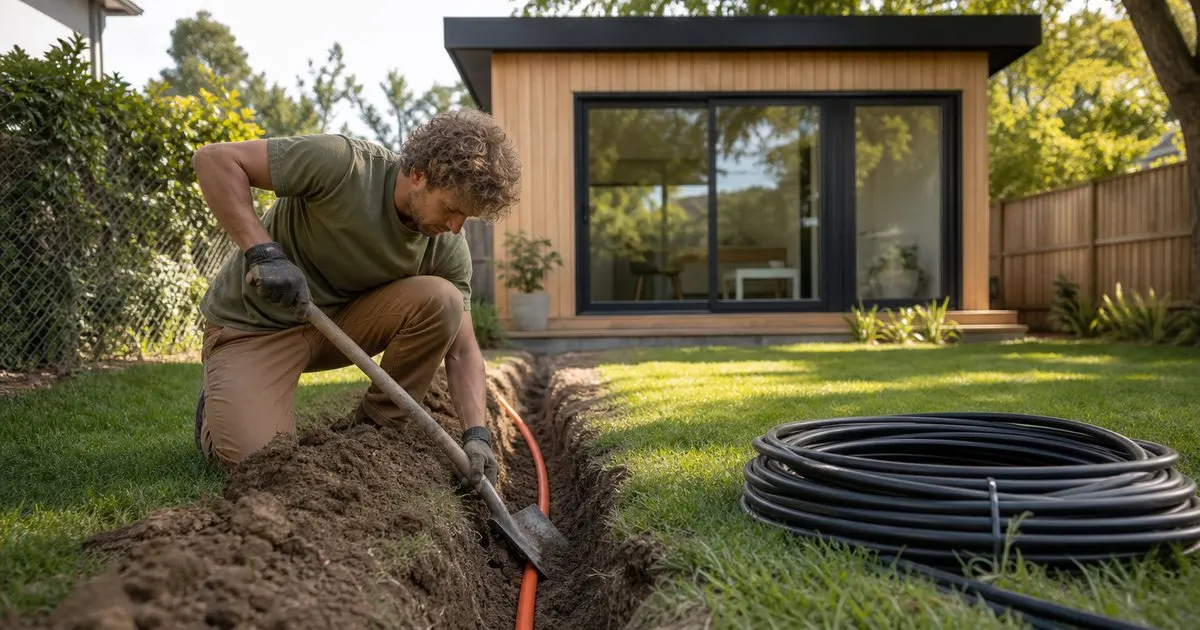
The electrical trench to your studio is a one time opportunity, and it is worth more than most owners realize. Whatever the electrician is doing for the power feed, ask for a second, separate conduit dedicated to low voltage data, and ask for a pull string left inside it. Data and line voltage should not share a raceway, both for code reasons in most jurisdictions and for signal quality. The marginal cost while the trench is already open is small. The cost of reopening a finished lawn, a paver path, or a new patio two years later is not, and that asymmetry is the whole argument.
Specify the details rather than leaving them to chance. Use long sweep elbows instead of tight ninety degree fittings so cable can be pulled without damage, and oversize the conduit so a future run can be added beside the first. Trench depth is set by local code and by whether the conduit is rigid or flexible, so let the permit drive that number instead of a forum post. Terminate both ends in weather rated boxes above grade rather than at ground level where water collects. If the studio may one day host a camera, a doorbell, or an outdoor speaker, one extra conduit stub now saves a second excavation later. Related: Why Does Insulation Decide Whether A Studio Feels Like An Office?
Copper, fiber, or a wireless bridge across the yard
Shielded outdoor rated Cat6 or Cat6A is the straightforward answer for most yards. It carries gigabit speeds comfortably at typical backyard distances, and it can also deliver power over Ethernet to an access point or camera so the studio side needs no separate adapter. The practical ceiling for a single run is around one hundred meters, far beyond most residential lots. The real caution with copper between two structures is electrical: a surge or a difference in ground potential can travel the cable and take out gear at both ends. Bond and ground the run properly, and use surge protection where the cable enters each building. Related: What Separates A Real Garden Office From A Decorated Backyard Shed?
Fiber removes that risk entirely because glass carries no current, which is why it is the calmer choice in areas with frequent lightning or where the studio has its own subpanel. Pre terminated outdoor fiber with a small media converter at each end is now attainable for a home budget, and it future proofs the run past anything a home office will need. Where trenching is impossible, a point to point wireless bridge mounted high on the house and aimed at the studio can deliver a stable multi hundred megabit link, provided the two units have clear line of sight and are not shooting through a mature tree canopy that thickens every spring. Wireless is the retrofit answer, not the first choice.
Setting up the studio side so calls never drop
Once a wire reaches the building, resist the temptation to plug in a range extender. An extender repeats a weak signal and halves throughput; what you want is a proper access point fed by that wire, so the studio broadcasts its own strong signal with a wired path home. Give it the same network name and security settings as the house so devices roam between them without prompting. Mount it on a wall or ceiling near the center of the room rather than tucking it behind a monitor or inside a cabinet, and keep it away from the mini split head and any metal shelving. Related: Which Permits And Zoning Rules Apply Before Building A Garden Studio?
Then plan the small things that separate a working studio from a frustrating one. Put the network gear and your computer on a modest uninterruptible power supply so a brief outage does not end a client call or corrupt a file. Run at least one wired jack to the desk, because a hardwired connection is still the most reliable thing in the room. Keep a cellular hotspot or a phone plan with tethering as an honest backup. And test the whole chain during construction, while walls are still open, rather than discovering a crushed cable after the interior finish is on. Documenting where the conduit runs, with photos and a measurement from a fixed point, will be worth its weight the first time anyone digs in that yard again.
- Insulation, low emissivity glass, and metal siding all weaken Wi-Fi, so a studio needs its own signal source rather than a borrowed one.
- Add a separate low voltage conduit with a pull string while the power trench is open, and use long sweep elbows plus weather rated boxes at both ends.
- Shielded outdoor Ethernet suits most lots, fiber avoids surge and grounding risk between buildings, and a line of sight wireless bridge is the retrofit fallback.
- Feed a real access point with that wire, add a wired desk jack and a small battery backup, and test everything before the interior is closed up.

Julien Jimenez
Julien Jimenez is an independent software builder based in Paris. He designs, ships, and operates focused SaaS products for small businesses and independent professionals. Read the full author page.
Room To Think, Steps Away
A curated guide to premium garden offices and studios. Studioshedr is built to help you put this into practice.
Explore studiosMore from the Studioshedr blog
How Do You Choose A Backyard Studio That Works Year Round?
What Separates A Real Garden Office From A Decorated Backyard Shed?
Which Permits And Zoning Rules Apply Before Building A Garden Studio?
Get the complete backyard studios and offices guide
Our full buying guide, the price guide, and new research as we publish it. One email, no spam, unsubscribe any time.